


What Clients Want from Law Firms in 2026
Understanding what clients actually want, need and expect from law firms has never been more important. As competition intensifies, digital standards rise and client demographics shift, assumptions based on instinct or anecdote are no longer enough. To stand out, firms need to understand their clients properly and respond to what they value most.
The key takeaway from this year’s research is that while many client expectations remain familiar, the way those expectations are expressed is changing. As younger generations become the dominant users of legal services, firms need to keep pace with rising expectations around digital access, transparency and convenience, without losing sightof the human reassurance clients still value.
The Law Firm Marketing Club’s What Do Clients Want, Need and Expect? 2026 report draws on fresh research from 642 participants across the UK, exploring real client experiences, preferences and expectations when choosing and working with law firms.
This year’s report is produced by the Law Firm Marketing Club and sponsored by Katchr, whose perspective on data clarity, governance and client confidence adds another valuable dimension to the findings.
Here, we’ve highlighted the headline findings. The full report, including detailed breakdowns by demographic and individual charts, is available to LFMC members or can be purchased by non-members.
First impressions still matter, but consistency matters more
Initial contact with law firms remains dominated by phone calls, which are still the most common first point of contact overall at 43%. This is followed by email at 22%, meeting in person at 14% and walking into the office at 11%.
Encouragingly, first impressions are overwhelmingly positive. 82% of respondents rated their first impression of a law firm as brilliant or good, suggesting that most firms are getting the early stages of the relationship right.
However, the report also shows that a strong first impression only goes so far. Clients can lose confidence when the warmth, professionalism or attentiveness shown at the outset is not maintained throughout the matter. Some of the strongest negative comments came from respondents who felt the firm started well, then became distant, disinterested or inconsistent once the matter progressed.
For firms, the challenge is not simply creating a polished first contact. It is making sure that early promises are backed up by clear communication, joined-up delivery and sustained engagement from start to finish.
How clients choose a law firm in 2026
Client choice is still driven by trust, access and confidence in the people handling the work.
The traditional factors remain strong. Being able to meet a lawyer in person, choosing a firm nearby and relying on professional or personal recommendations all continue to rank highly. But around these fundamentals, expectations are shifting.
Clients increasingly expect a hybrid experience. They still value personal contact and human reassurance, but they also want digital convenience alongside it. A strong website, positive online reviews and good search visibility now carry almost as much weight as traditional word of mouth, particularly among clients under 45. This shift is most visible among younger audiences and more recent users of legal services, who place greater importance on digital touchpoints and the ability to progress matters remotely.
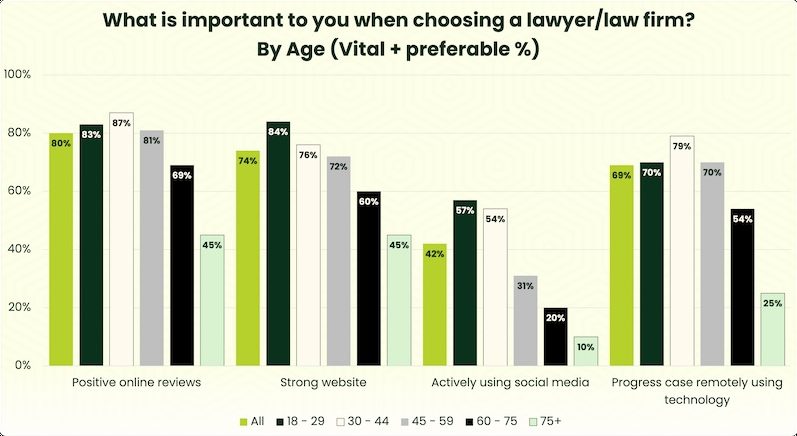
This does not mean firms need to abandon the personal side of service. It means combining the best of both: trusted human support alongside a smoother and more visible digital experience.
Your law firm’s website is often the first real interaction
Clients increasingly treat a law firm’s website as their first meaningful interaction with the firm, rather than just a place to gather basic details.
The findings are very clear about what clients expect to see online. The top priorities are a description of services, an indication of likely costs, a clearly displayed telephone number, lawyer profiles, direct contact details for fee earners and contact details for support staff.
These are no longer optional extras. They are simply expected.
Clients also want reassurance that the firm is credible and experienced. That is why examples of how the firm helps clients, testimonials and articles demonstrating knowledge all remain important. Business clients in particular place greater value on these expertise signals than personal clients.
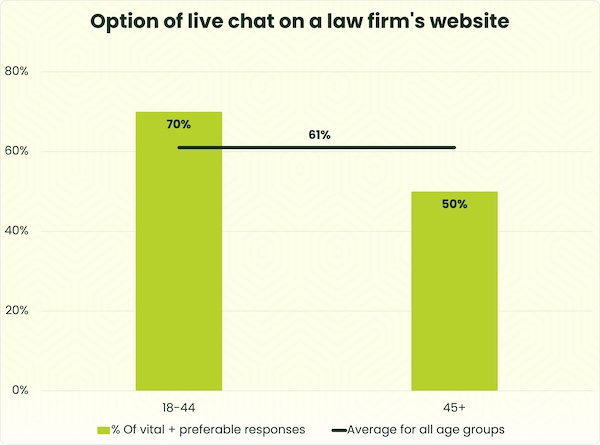
Live chat is another area where expectations are growing. On average, across all age groups, 61% of respondents said they expect to see live chat on a law firm’s website, rising to 70% among under 45s and 75% among business clients. For a growing share of the market, this kind of immediate digital access is becoming part of what good service looks l
ike before a conversation has even started.
A law firm’s website should not be treated as a static brochure. It is a core partof the client journey and one of the strongest opportunities firms have to build trust early.
Client attitudes towards AI in legal services are shifting, but not how you might expect
Artificial intelligence was added as a new area of focus in this year’s research by our research sponsor, Katchr, and the results point to a more balanced picture than many firms might expect.
Overall, 45% of clients said they were completely or slightly comfortable with AI being used to support the delivery of legal services. By contrast, 32% said they were completely or slightly uncomfortable, while 22% said they were not sure.
That uncertainty is telling. It suggests many clients are not rejecting AI outright, but they do want more clarity and reassurance about how it is being used.
Clients are most comfortable with AI being used for research purposes. They are less comfortable with it being used for case management and administration.
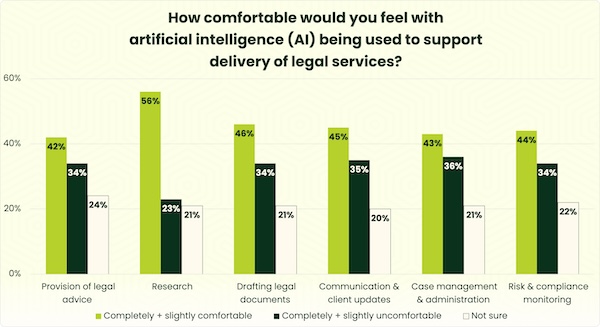
Attitudes also differ sharply by audience. Younger respondents are much more open to AI, with half of those aged 18 to 29 and 56% of those aged 30 to 44 saying they are comfortable with its use. Among respondents aged 75 and over, that figure drops to 25%.
Business clients are also notably more comfortable with AI than personal clients, at 62% compared with 42%.
The key message from Katchr for firms is that trust depends on transparency. Clients want to know where AI is being used, how it is managed and where human judgment remains central. They may accept innovation, but only where it is clearly governed and responsibly applied.
Katchr’s sponsorship reflects a growing focus on clarity and confidence
Katchr’s perspective is that clients are not asking for reinvention. They are asking for clarity, consistency and confidence. That applies to communication, service delivery and increasingly to the way firms manage and use their data.
As the report shows, trust can quickly weaken when communication is fragmented, expectations are unclear or the client experience feels disjointed. Katchr’s focus on bringing together data from across the firm speaks directly to that issue. Better visibility across matters, teams and performance allows firms to communicate more consistently, manage expectations more effectively and create a more joined-up client experience.
Sustainability is becoming more important, especially for younger and business clients
Sustainability is not yet the main factor in how most clients choose a law firm, but it is becoming a more visible part of the decision-making picture.
This year, 40% of respondents said a law firm’s approach to sustainability was very important or important when choosing a firm. That is slightly lower than in 2024, but still points to a substantial proportion of the market seeing sustainability as meaningful.
The generational difference is especially clear. Among respondents aged up to 45, 48% said sustainability was important. Among those aged 45 and over, that figure drops to 29%.
Business clients place even more weight on the issue. 60% said sustainability was important as part of their selection criteria, compared with 36% of personal clients.
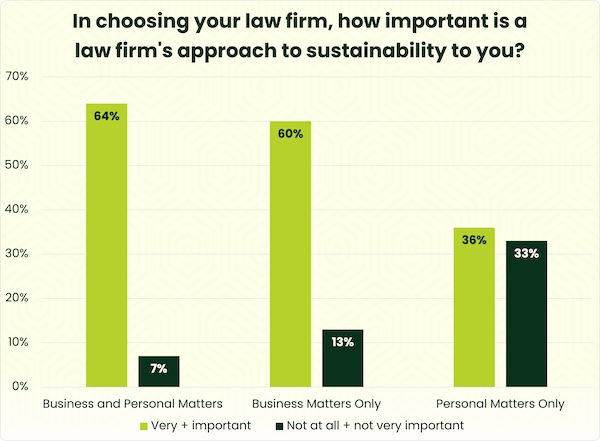
For many clients, sustainability may still act more as a differentiator than a deciding factor. They are unlikely to choose a firm on this basis alone, but it can influence how modern, responsible and credible a firm appears when other core factors are evenly matched. That matters all the more as younger audiences continue to grow in importance.
Diversity and inclusion remain important to a growing share of clients
Diversity and inclusion are also playing a bigger role in how clients assess law firms.
This year, 51% of respondents said a law firm’s approach to diversity and inclusion was very important or important. Around one in five said it was not very important or not important at all.
Again, age is one of the clearest dividing lines. Among 18 to 44 year olds, 62% said diversity and inclusion were important. Among those aged 75 and over, that falls to 30%.
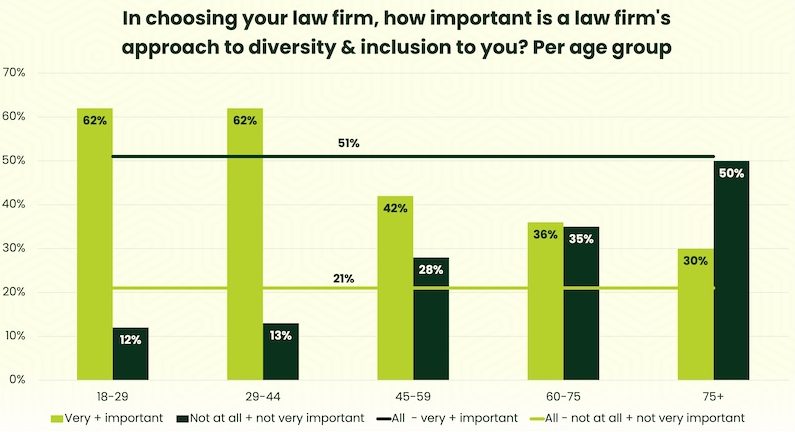
Business clients are especially likely to care about this area. 65% ranked diversity and inclusion as important in their selection criteria, compared with 36% of private clients.
For many firms, the challenge is not whether diversity and inclusion matter, but how to communicate them well. Clients still want excellent lawyers and strong results. Increasingly, though, they also expect firms to reflect modern values, create fair and inclusive cultures and demonstrate that different perspectives strengthen the work they do.
As younger clients become a larger share of the market, diversity and inclusion will only become more significant in shaping trust, reputation and long-term positioning.
Rising expectations are now the baseline
What once might have felt like exceptional service now looks increasingly like the minimum standard.
Clients expect direct contact details, prompt responses, regular updates and convenient access to information as a normal part of working with a law firm. The most highly ranked expectations in this year’s research were direct contact details at 88%, at least weekly updates at 85%, same-day responses at 83% and an online account for updates and documents at 81%.
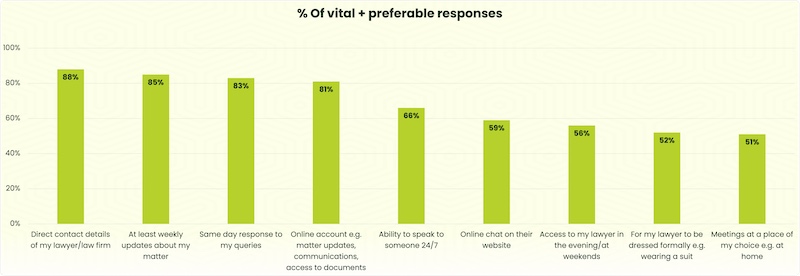
This data is strikingly consistent with the previous survey, which suggests these expectations are now firmly embedded.
Younger clients continue to raise the bar on digital access. Among those aged 18 to 29, 67% said online chat was important and 75% said 24/7 access was important. Older clients are less focused on always-on access, but still place strong value on reliability, clarity and human reassurance.
The takeaway is simple. Clear, proactive communication is now expected as standard, not a differentiator. At the same time, expectations around access are beginning to stretch, particularly among younger clients who are more likely to value online chat and 24/7 availability. Firms don’t need to be constantly available in a literal sense, but they do need to provide a level of accessibility and responsiveness that reflects how clients are used to engaging with other services.
Value, loyalty and what drives repeat instructions
Overall satisfaction is strong, and this year’s results are more positive than last year’s across all measured criteria.
Service remains the strongest area, with 84% saying firms met expectations here. Price is still the weakest point, although even that has improved modestly, rising from 63% in 2024 to 68% in 2026.
This tells an important story. Clients are broadly happy with the quality of service they receive, but cost and pricing transparency continue to create friction. The problem is often not just the final fee itself, but the gap between what clients expected and what they were ultimately charged.
Loyalty looks strong on the surface. 89% of respondents said they would use the same law firm again. However, this is higher than the number who have actually done so in the past. Among respondents who had instructed a law firm more than once, only 56% said they had used the same firm for all legal matters.
This gap suggests that firms should not assume satisfaction automatically turns into repeat work. Retention depends on staying visible, communicating the full breadth of services available and treating each matter as the start of a longer-term relationship rather than a one-off transaction.
Access the full What Do Clients Want, Need and Expect? 2026 report
This landing page highlights only the headline findings from the Law Firm Marketing Club’s latest research.
The full report, including demographic-specific analysis, individual charts, detailed commentary and sponsor insight from Katchr, is available to all LFMC members as part of their membership.
If you would like to purchase the report or join the Law Firm Marketing Club, please contact laura@lawfirmmarketingclub.com for more information.